Rachel Nipp
Whether you are a ‘words of affirmation’ lover through saying supportive things, choose to show love through gifts, or would rather do helpful things for your partner through ‘acts of service’, a love language is as unique as the individual. But which love languages are the most popular, and how do they shape our relationships?
We asked 3,000 Americans which love languages resonate the most with them when receiving and giving love, what activities they prefer to do with their partners, and which traditional dating rules they still follow today. Discover what we found about how couples choose to connect with their loved ones.
The Most Common Love Languages
To quote the iconic rom-com Love Actually, “You’ll find that love actually is all around.” Whether it’s a grand, public gesture or making someone a warm cup of coffee, you will spot love in all forms. According to relationship counselor Dr. Gary Chapman, love languages consist of 5 different ways people prefer to give and receive love. With 18,100 monthly searches for ‘what is my love language’ in the US, it’s fair to say that people are curious to understand how they show affection towards their loved ones and what they wish for in return.
Love languages can be split into five different categories:
- Words of Affirmation: Using words to express your feelings such as saying or writing ‘I love you.’
- Acts of Service: Doing activities that make your partner’s life easier such as running errands or completing household chores.
- Quality Time: Spending uninterrupted, fully dedicated time with your partner without distractions such as phones or other people.
- Gift Giving: Showing affection through giving or receiving gifts.
- Physical Touch: Physical contact with your partner such as cuddling, hugs, or holding hands.
When it comes to receiving love, the most popular love language is quality time, with over a quarter (27%) of Americans choosing this as their favorite way for their partner to show love. This can be as simple as planning a date night, or even making time for deep, meaningful conversations.
Physical touch comes in second overall for the most desired expression of love, with nearly 1 in 4 (24%) respondents feeling the love the most when they’re physically intimate with their partner.
Hearing loving words rounds off the top three love languages, with 22% wishing for words of affirmation. While this comes in overall third for the country, those aged between 21 and 24 prefer compliments and caring words above all else at 30%.
Mapping the Heart of America
Out of all 50 states, 18 chose physical intimacy as their favorite love language. Residents that desire physical contact the most can be found in North Dakota (50%), Arizona (43%), and Idaho (43%). But for those that love to hold hands or a quick kiss, you may want to stay away from Washington or Maryland, where less than 10% of the people wish for physical contact.
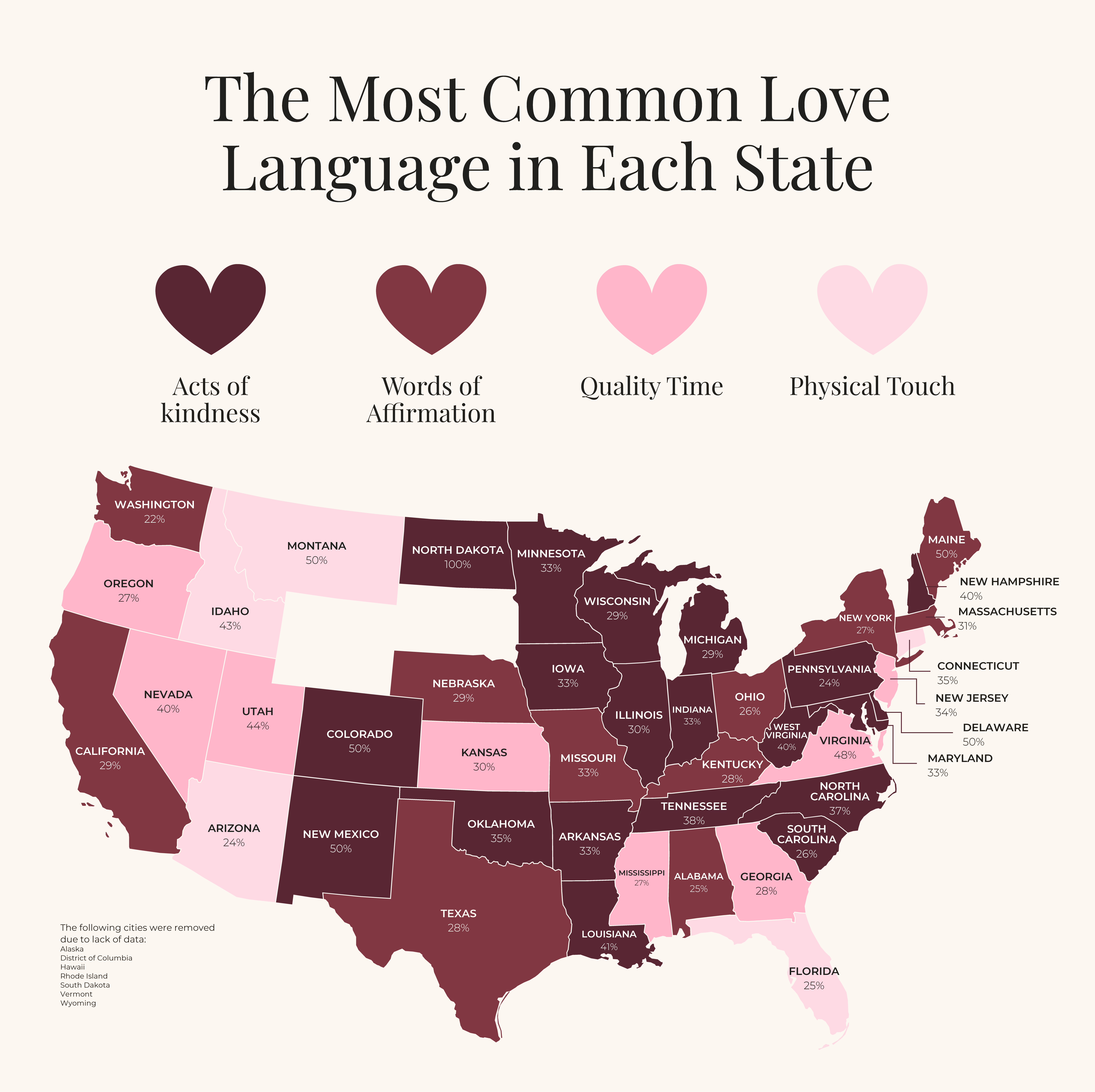
A fifth of states would rather hear the love from their partner than be shown. The people of Maine appreciate declarations of love the most, with three in four people naming words of affirmation as their chosen love language. You may not hear many ‘I love you’s’ in Iowa or Oklahoma though, where loving words are only wanted or needed by 7% and 6%, respectively. Instead, residents here would much prefer quality time above any other love language.
For a staggering half of the 50 states, people feel most loved through quality time with their partner. The people of Iowa desire meaningful time with their loved one the most out of any state, planning dates at Eagle Point Park or choosing a night in. In New Mexico, despite beautiful date spots, couples are ditching romantic outings (10%) and would rather show their love through physical intimacy.
How Do People Express Their Affection?
While most people prefer to receive quality time from their partner, the most popular way of showing affection is actually through acts of service, with a quarter of the respondents saying they prefer to offer help to their partner over any other love language. Despite it being such a popular way for people to show they care, this love language doesn’t even appear in the top three for how people want to receive love, suggesting that there may be a slight imbalance between those providing acts of service, and those actually wanting it.

Expressing your feelings through words comes second for the most popular way to give love at 22% of the population. And for the most vocal part of the country, a whole quarter of the Northeast prefer to say how they feel compared to any other love language. Interestingly, the most popular way to receive love in these parts is physical touch at 23%, but only 17% express their love this way.
While quality time came on top for the favorite way to receive love, it comes into third place for giving love, at 20%. But when it comes to finding a partner that will plan intimate dates or schedule time for the two of you, a partner from Virginia will fulfill any needs for quality time, as just under half of the population (48%) prefer to spend meaningful time together. And with 37% wanting to provide that quality time, matchmaking in Virginia should be a breeze.
How do people like to connect with their partner?
If you have a different love language to your partner, have no fear, as this can actually strengthen the bond you have with each other. Love languages aren’t gospel and alot of people find that they identify with more than one. Relationships are all about compromise and learning all about your partner, so having a different love language can be a beautiful opportunity to deepen the bond between you.
When asked what their favorite ways are to connect with their partner, 27% of those surveyed said that they wish for quality time from their partner, and an impressive 42% said that simply spending a quiet evening at home together is their favorite way to connect. So, even among the 78% who may not have chosen quality time as their top love language, many can still find magic in the simple joys it brings, like a cozy night in together, sharing quiet moments and building lasting memories. Quality time has a way of warming hearts, even if it’s not everyone’s first choice.
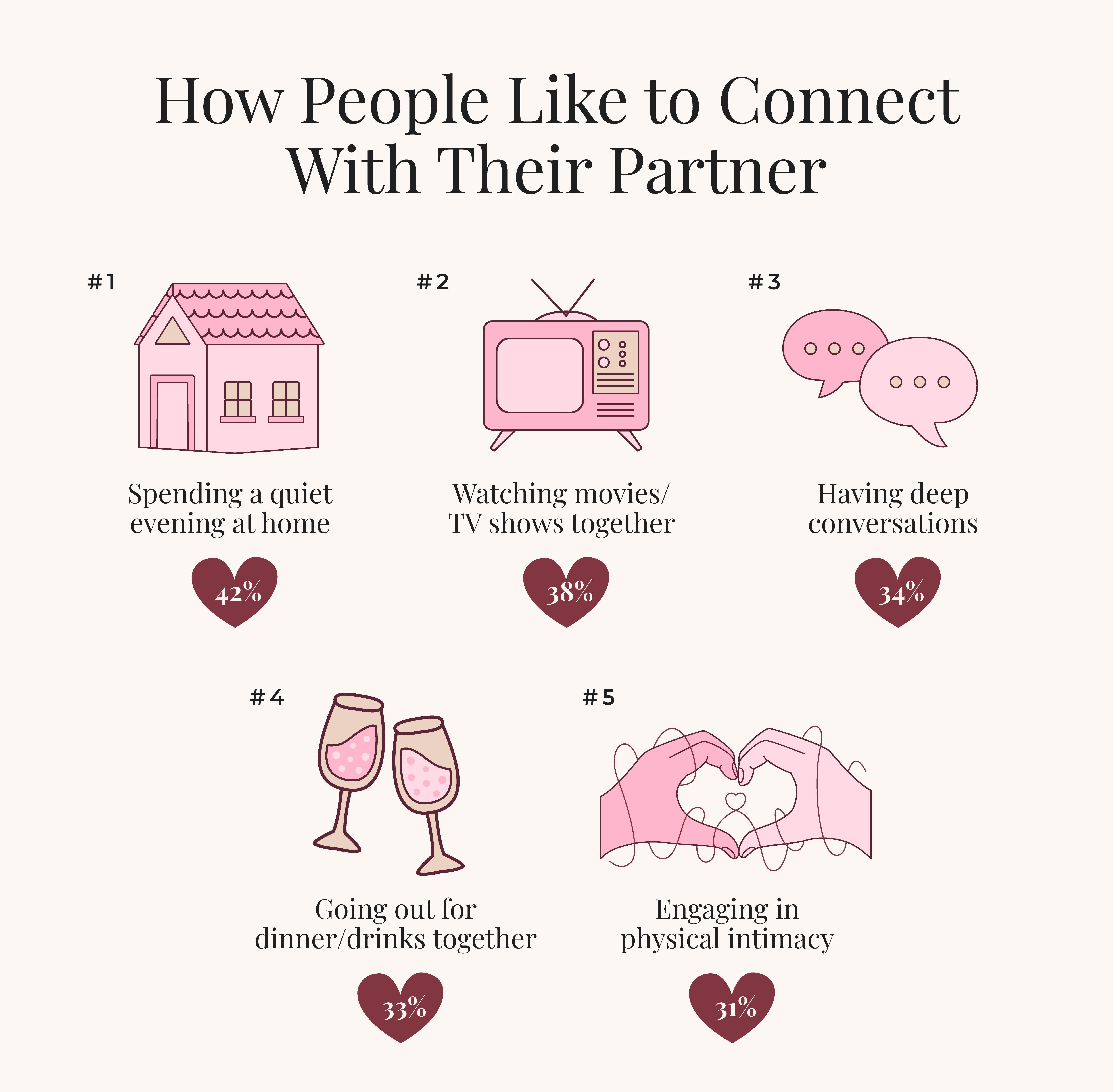
Not only do couples like to reconnect with a chilled night at home, but 38% also enjoy a movie marathon or binge watching session with their partner. This is particularly love in the Southern states, where 40% of the population name it their favorite way to bond.
Deep conversations are the third overall favorite way to bond with your partner, with 34% of couples wanting meaningful talks. Heart-to-heart conversations are actually the top way to connect for those aged between 21 and 24, with 57% of the generation favoring this method of connection. Gen Z have become a generation of authenticity and open communication. For example, they are 32% less likely to ghost someone than those aged over 33 and 64% are accepting their ‘cringey’ side in order to be genuine. With their willingness to be authentic, the younger generations appreciate the vulnerability of meaningful conversations.
Are ‘traditional’ dating rules still relevant?
With the introduction of dating apps and speed dating, ‘traditional’ dating has adapted with the societal and technological changes. But as dating becomes a more casual and laid-back experience, how much tradition is still being kept despite the countless situationships and app matches?
While some women insist on splitting the bill on a first date, the tradition of the man paying for the dates is still the most widely held custom, with over a third (36%) of respondents saying they still abide by this. In fact, both women and men have this as their most commonly held tradition, with 40% of men following it and 32% of women preferring it. It also doesn’t seem to be disappearing through generations, as just over a quarter of those aged 21 to 24 still carry on the tradition.
Another gender-specific dating rule comes second, with a third of couples sticking to the man proposing. However, presenting an engagement ring to your male partner is becoming increasingly popular, with the search term ‘can a woman propose’ increasing by +22% in the US in the last year. And for those sharing their proposals online, over 500 TikTok posts are tagged with #sheproposed, and over 11,000 Instagram posts can be found under the same hashtag.
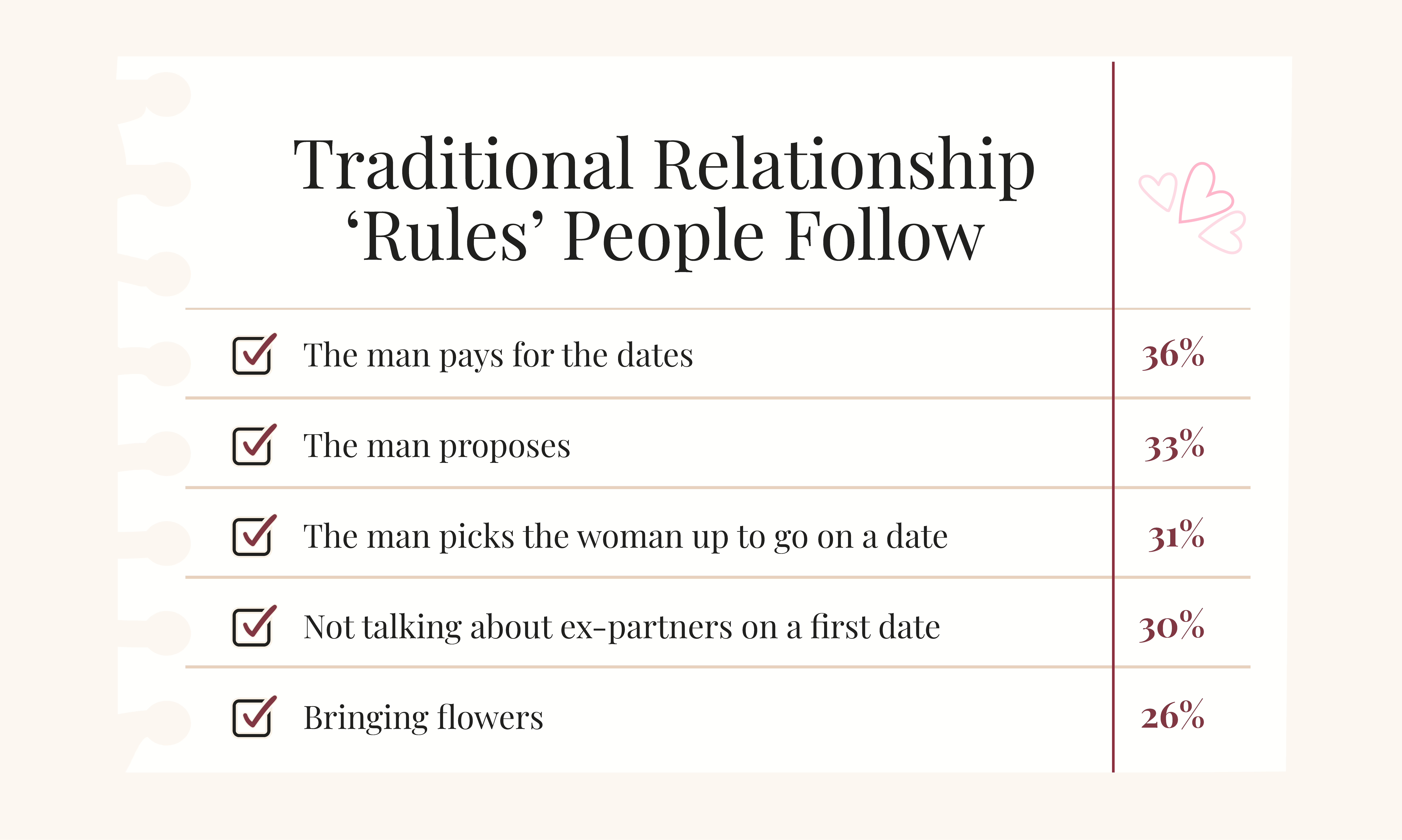
Before you even get to marriage, you get to enjoy the ‘butterflies in the stomach’ feelings of the dating stage. While romance can feel hard to achieve with the increase in casual dating and dating apps, the tradition of the man coming up to the door and picking up his date from their home is still prominent today, with 31% still following the custom. While you may not get this treatment from a date in North Dakota, where only 9% pick up their date, you will still find the traditional gentleman in New Mexico (50%) or Arizona (43%).
Methodology
We surveyed over 3,000 Americans on their connection preferences on how they prefer to give and receive love, as well as which dating traditions they follow. Survey was conducted in October 2024.
Fair Use Statement
If you would like to use this data, you are welcome to share any of the information or graphics above for non-commercial purposes. We just ask that you include a link to this page in your article when referencing the material.

 Anna Gionet
 Rachel Nipp